Understanding Legal Specialisations in Turkey: A Guide for Foreign Clients
Legal matters in Turkey can involve very different laws, authorities, courts, documents and procedural requirements.
A residence permit refusal does not follow the same process as a divorce case. A criminal investigation is different from a commercial contract dispute. A property purchase requires a different type of analysis from debt enforcement or a Turkish citizenship application.
For this reason, clients should not choose a lawyer only because the lawyer is licensed, speaks their language or has many years of professional experience.
The lawyer should also have experience relevant to the subject and procedural stage of the matter.
A lawyer may work across several related fields, while larger firms may divide work among different practice groups. Some matters also require cooperation between lawyers with different areas of experience.
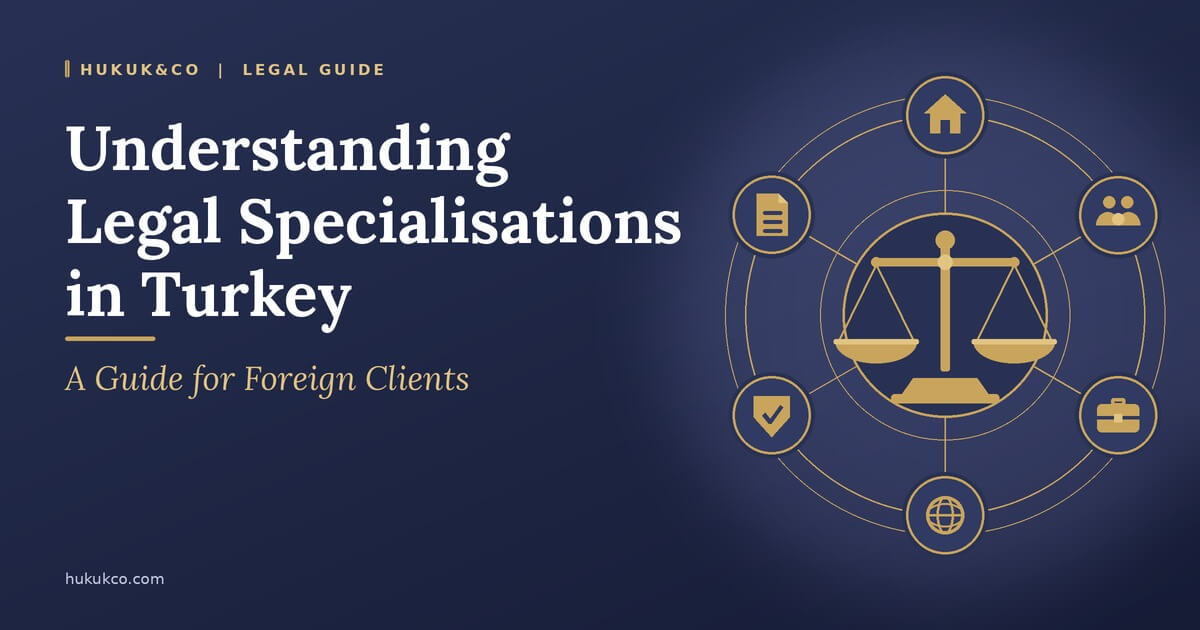
This guide explains the main legal practice areas foreign individuals and international businesses may encounter in Turkey and how to identify the appropriate type of legal support.
Quick Answer
The main legal specialisations relevant to foreign clients in Turkey include:
- Immigration and residence law
- Turkish citizenship law
- Property and real-estate law
- Family and divorce law
- Inheritance and estate planning
- Corporate and commercial law
- Employment and labour law
- Commercial litigation and arbitration
- Debt recovery and enforcement
- Criminal law and investigations
- Administrative law
- Tax law
- Intellectual-property law
- Technology, privacy and digital law
- Consumer law
- Construction law
- Maritime and transport law
- International and cross-border legal matters
The appropriate lawyer depends not only on the legal subject, but also on whether the matter concerns advice, an application, a transaction, negotiation, litigation, appeal or enforcement.
At a Glance
| Legal Area | Typical Matters |
| Immigration | Residence permits, deportation, entry bans and work permits |
| Citizenship | Investment, marriage, ancestry and administrative disputes |
| Property | Purchases, title checks, contracts, disputes and tenancy |
| Family | Divorce, custody, maintenance and protection orders |
| Inheritance | Estates, succession, wills and foreign heirs |
| Corporate | Company formation, governance and share transfers |
| Commercial | Contracts, distribution, investment and business advice |
| Employment | Employment agreements, dismissal and employee claims |
| Litigation | Court claims, defence, evidence and appeals |
| Arbitration | Domestic and international commercial disputes |
| Debt recovery | Enforcement, payment orders, attachment and collection |
| Criminal | Complaints, investigations, defence and victim representation |
| Administrative | Challenges to public-authority decisions |
| Tax | Assessments, penalties and tax disputes |
| Intellectual property | Trademarks, copyright, patents and infringement |
| Digital law | Privacy, data protection, e-commerce and cyber disputes |
| Construction | Development contracts, defects and contractor disputes |
| Consumer | Defective goods, services and consumer claims |
| Maritime | Shipping, cargo, transport and maritime disputes |
What Does Legal Specialisation Mean?
Legal specialisation generally refers to a lawyer’s concentration, experience or professional focus in a particular field of law.
It may be demonstrated through:
- Regular work in the area
- Experience with the relevant courts or authorities
- Handling similar applications or disputes
- Drafting specialised contracts
- Representing clients in related proceedings
- Postgraduate study
- Professional training
- Publications or teaching
- Membership in relevant professional organisations
- Practical knowledge of the relevant industry
Formal qualification as a lawyer and legal specialisation are not the same.
A licensed lawyer may be professionally entitled to practise but may not regularly handle every type of legal matter.
Clients should therefore assess both:
- whether the person is a qualified and registered lawyer; and
- whether that lawyer has meaningful experience in the relevant area.
Why the Correct Legal Specialisation Matters
Different legal matters may require different procedural knowledge.
For example:
- An immigration refusal may require administrative litigation.
- A divorce case may proceed before a family court.
- An employment dispute may involve mandatory mediation before litigation.
- A commercial dispute may belong before a commercial court or an arbitral tribunal.
- An unpaid debt may begin through an enforcement office rather than an ordinary lawsuit.
- A criminal complaint may require evidence preservation and prosecutorial investigation.
- A property transaction may require due diligence before any dispute arises.
Turkey has civil, criminal and specialised courts dealing with different categories of matters, including family, labour, commercial, enforcement and cadastral disputes. Official Ministry of Justice courthouse listings illustrate this division between criminal, civil and specialised judicial bodies. (AYDIN ADLİYESİ)
Choosing a lawyer without the appropriate procedural experience may create risks such as:
- Filing before the wrong authority
- Missing a deadline
- Using an unsuitable legal remedy
- Failing to preserve evidence
- Overlooking mandatory preliminary procedures
- Underestimating enforcement difficulties
- Paying for work that does not address the actual problem
1. Immigration and Residence Law
Immigration law concerns the entry, stay, residence and removal of foreign nationals in Turkey.
Common matters include:
- Short-term residence permits
- Family residence permits
- Student residence permits
- Long-term residence permits
- Humanitarian residence permits
- Residence permit refusals
- Residence permit cancellations
- Overstay issues
- Deportation decisions
- Entry bans
- Administrative detention
- Removal-centre procedures
- International protection
- Work permits
- Administrative applications and lawsuits
Immigration matters often require careful review of:
- Nationality
- Entry history
- Passport validity
- Current immigration status
- Previous applications
- Refusal decisions
- Family circumstances
- Employment
- Education
- Medical or humanitarian factors
- Applicable deadlines
A lawyer handling immigration matters should understand both the underlying immigration rules and the administrative procedures used to challenge decisions made by public authorities.
When Immigration Experience Is Especially Important
Relevant experience is particularly important where the client:
- Has received a deportation decision
- Is held in a removal centre
- Has an entry restriction
- Has overstayed
- Has received a residence permit refusal
- Has previously submitted inconsistent applications
- Faces an urgent administrative deadline
- Has complex humanitarian or family circumstances
2. Turkish Citizenship Law
Citizenship matters may involve several different legal bases.
These may include:
- Citizenship by investment
- Citizenship through real-estate investment
- Citizenship through a bank deposit
- Citizenship by marriage
- Citizenship by descent
- Ottoman ancestry claims
- Exceptional citizenship
- Restoration or confirmation of citizenship status
- Administrative refusal or cancellation disputes
Citizenship work may overlap with:
- Property law
- Banking
- Civil-status records
- Immigration law
- Administrative law
- Foreign-document authentication
- Inheritance
- Family law
A lawyer working on citizenship matters should distinguish between:
- Eligibility
- Document preparation
- Investment compliance
- Civil-status problems
- Administrative review
- Litigation following an adverse decision
Completing an investment or submitting documents does not allow any lawyer or intermediary to guarantee citizenship approval.
3. Property and Real-Estate Law
Property law is one of the most important practice areas for foreign clients in Turkey.
It may involve:
- Property due diligence
- Title-deed verification
- Purchase agreements
- Deposits and reservation agreements
- Encumbrances
- Mortgages
- Construction status
- Zoning
- Developer contracts
- Title-deed transfers
- Shared ownership
- Property fraud
- Construction defects
- Tenancy
- Eviction
- Inheritance of property
- Property-based residence or citizenship matters
A property lawyer should act independently from:
- The seller
- The developer
- The real-estate agent
- The marketing company
- Other commercial intermediaries
Transactional and Dispute Experience
Property work may be preventive or contentious.
A transactional property lawyer may focus on:
- Reviewing title records
- Drafting and negotiating contracts
- Identifying encumbrances
- Structuring payments
- Managing transfer formalities
A property-litigation lawyer may focus on:
- Deposit recovery
- Ownership disputes
- Fraud claims
- Construction defects
- Tenant disputes
- Cancellation or registration claims
The client should confirm which type of experience is required.
4. Family, Marriage and Divorce Law
Family law may involve highly personal and urgent issues.
Common matters include:
- Divorce
- Contested divorce
- Uncontested divorce
- Child custody
- Visitation
- Child support
- Spousal maintenance
- Compensation
- Marital property
- Domestic violence
- Protection orders
- Paternity
- International child disputes
- Recognition of foreign divorce judgments
International family matters may require consideration of:
- The spouses’ nationalities
- Place of residence
- Location of children
- Foreign court proceedings
- Assets in more than one country
- International service
- Recognition and enforcement
- Immigration consequences
A lawyer handling family matters should be able to address both the legal dispute and any immediate protective measures required.
5. Inheritance and Estate Planning
Inheritance matters may affect foreign nationals who own property, shares, bank accounts or other assets in Turkey.
Relevant work may include:
- Determining legal heirs
- Obtaining inheritance certificates
- Estate administration
- Wills
- Testamentary dispositions
- Inheritance disputes
- Renunciation of inheritance
- Division of estate assets
- Tax coordination
- Transfer of inherited property
- Foreign heirs
- Recognition of foreign documents
- Cross-border estates
Inheritance cases may overlap with:
- Family law
- Property law
- Company law
- Tax law
- Private international law
- Civil-registry matters
A lawyer handling an international estate should understand how Turkish procedures interact with foreign nationality, residence, documents and overseas succession proceedings.
6. Corporate Law
Corporate law concerns the formation, governance, restructuring and operation of companies.
Common services include:
- Company formation
- Limited liability companies
- Joint-stock companies
- Branch establishment
- Liaison offices
- Share transfers
- Capital increases
- Corporate governance
- Board and shareholder decisions
- Company amendments
- Mergers and acquisitions
- Liquidation
- Corporate compliance
- Beneficial ownership
- Trade-registry procedures
Corporate legal work often requires coordination with:
- Accountants
- Tax advisers
- Notaries
- Trade registries
- Banks
- Foreign counsel
- Regulatory authorities
A corporate lawyer should understand the client’s business model, ownership structure, planned activities and commercial objectives.
7. Commercial and Contract Law
Commercial lawyers advise businesses on their contractual and operational relationships.
This may include:
- Commercial contracts
- Distribution agreements
- Agency agreements
- Supply agreements
- Franchise agreements
- Shareholders’ agreements
- Joint ventures
- Service agreements
- Confidentiality agreements
- Licensing
- International trade
- Terms and conditions
- Contract termination
- Commercial negotiations
The lawyer should consider:
- Governing law
- Jurisdiction
- Arbitration
- Payment terms
- Liability
- Termination
- Confidentiality
- Intellectual property
- Compliance
- Enforcement
A contract should not be reviewed only for grammar or translation. The lawyer should assess its legal and commercial consequences.
8. Employment and Labour Law
Employment law concerns the relationship between employers and employees.
It may involve:
- Employment agreements
- Workplace policies
- Salaries and benefits
- Working time
- Overtime
- Leave
- Disciplinary matters
- Termination
- Severance pay
- Notice pay
- Workplace harassment
- Discrimination
- Reinstatement claims
- Employee claims
- Work permits for foreign employees
- Social-security matters
- Internal investigations
Employment lawyers may advise:
- Employees
- Employers
- Senior executives
- Foreign companies
- International employees
Some employment disputes may require preliminary procedures before litigation. The lawyer should identify the applicable route and deadline at the beginning.
9. Commercial Litigation
Commercial litigation concerns disputes arising from business relationships.
Examples include:
- Breach of contract
- Unpaid invoices
- Shareholder disputes
- Distribution disputes
- Agency disputes
- Construction claims
- Company-management disputes
- Unfair competition
- Damages
- Interim measures
- International trade disputes
A commercial litigator should evaluate:
- Contractual rights
- Evidence
- Jurisdiction
- Governing law
- Limitation periods
- Mandatory mediation
- Interim protection
- Counterclaims
- Appeal
- Enforcement
- Debtor assets
Commercial litigation should be approached as both a legal and business problem.
10. Arbitration
Arbitration is a private dispute-resolution process agreed by the parties.
It may be used in:
- International trade
- Construction
- Energy
- Shareholder disputes
- Distribution
- Shipping
- Investment
- Major commercial contracts
Arbitration work may involve:
- Reviewing arbitration clauses
- Selecting the arbitral institution
- Determining the seat
- Choosing governing law
- Appointment of arbitrators
- Written submissions
- Hearings
- Interim measures
- Challenges
- Recognition and enforcement of awards
A lawyer experienced in ordinary court litigation may not necessarily have substantial arbitration experience.
Clients should ask whether the lawyer has worked with the relevant:
- Arbitral rules
- Institution
- Seat
- Governing law
- Language
- Industry
11. Debt Recovery and Enforcement
Debt recovery concerns obtaining payment or performance from a debtor.
It may include:
- Demand letters
- Settlement negotiations
- Payment orders
- Enforcement proceedings
- Objections
- Attachment
- Bank-account seizure
- Asset investigation
- Enforcement litigation
- Bankruptcy-related procedures
- Enforcement of judgments
- Enforcement of foreign judgments or awards
A debt-recovery lawyer should consider not only whether the creditor has a valid claim, but also whether recovery is commercially realistic.
Important questions include:
- Does the debtor have assets?
- Is the debt documented?
- Is there a limitation issue?
- Can the debtor object?
- Is interim protection needed?
- Is settlement preferable?
- Will a foreign decision require recognition?
Winning a lawsuit does not automatically result in payment.
12. Criminal Law and Investigations
Criminal law concerns alleged criminal offences and related investigations.
A criminal matter may involve:
- A complainant
- A victim
- A suspect
- An accused person
- A witness
- A public prosecutor
- Police or gendarmerie
- Criminal courts
Common issues include:
- Fraud
- Theft
- Threats
- Violence
- Harassment
- Defamation
- Forgery
- Cybercrime
- Financial offences
- Drug offences
- Immigration-related allegations
- Company-related criminal liability
A criminal lawyer may assist with:
- Complaints
- Statements
- Detention
- Evidence preservation
- Search and seizure
- Judicial-control measures
- Defence
- Victim representation
- Trial
- Appeal
Criminal matters may require immediate legal advice, especially where detention, questioning or urgent evidence is involved.
13. Administrative Law
Administrative law concerns decisions and actions of public authorities.
Examples include:
- Residence permit refusals
- Deportation decisions
- Entry restrictions
- Citizenship decisions
- Licensing
- Municipal decisions
- Zoning
- Administrative fines
- Regulatory penalties
- Public employment
- Public tenders
- Tax-related administrative decisions
Administrative matters may involve:
- Administrative applications
- Objections
- Annulment proceedings
- Compensation claims
- Suspension of execution
- Administrative courts
- Regional administrative courts
- Higher administrative review
Administrative deadlines may be short and specific.
A lawyer experienced only in private disputes may not be suitable for a case challenging a government decision.
14. Tax Law
Tax lawyers advise individuals and businesses on tax obligations and disputes.
Common matters include:
- Tax assessments
- Tax penalties
- Corporate tax issues
- VAT
- Withholding
- Customs-related matters
- Tax inspections
- Transfer pricing
- International taxation
- Double-taxation issues
- Tax litigation
- Public receivables
Tax work may require cooperation between:
- Lawyers
- Certified public accountants
- Tax advisers
- Financial experts
The client should understand which professional is providing legal advice and which professional is handling accounting or tax calculations.
15. Intellectual-Property Law
Intellectual-property law protects commercial and creative rights.
It may include:
- Trademarks
- Patents
- Utility models
- Industrial designs
- Copyright
- Trade names
- Domain names
- Licensing
- Franchising
- Counterfeit goods
- Infringement
- Unfair competition
- Online brand misuse
An intellectual-property lawyer may provide:
- Registration advice
- Portfolio management
- Opposition
- Cancellation
- Licensing
- Enforcement
- Litigation
- Customs-related protection
Registration work and infringement litigation require different practical skills. Clients should identify which type of support is needed.
16. Technology, Privacy and Digital Law
Digital legal matters increasingly affect both individuals and businesses.
They may concern:
- Data protection
- Privacy
- KVKK compliance
- Data processing
- Data breaches
- E-commerce
- Online platforms
- Digital contracts
- Software agreements
- Cybersecurity
- Artificial intelligence
- Online defamation
- Social-media disputes
- Digital evidence
- Cybercrime
- Electronic signatures
Technology matters may overlap with:
- Intellectual property
- Consumer law
- Employment law
- Criminal law
- Corporate compliance
A lawyer should understand both the legal framework and the technology or business process involved.
17. Consumer Law
Consumer law may apply where an individual purchases goods or services for personal use.
Common disputes include:
- Defective goods
- Defective services
- Refunds
- Warranties
- Distance sales
- Online purchases
- Package travel
- Private education
- Healthcare services
- Construction and residential purchases
- Subscription agreements
The appropriate procedure may depend on:
- Value of the claim
- Type of transaction
- Consumer status
- Contract terms
- Mandatory application mechanisms
- Evidence
Consumer disputes may be handled differently from ordinary commercial disputes between businesses.
18. Construction Law
Construction law involves technical, contractual and property-related issues.
It may include:
- Construction contracts
- Contractor disputes
- Delay
- Defects
- Additional works
- Payment claims
- Performance guarantees
- Termination
- Development agreements
- Urban transformation
- Engineering evidence
- Expert reports
- Arbitration
- Litigation
Construction cases frequently require cooperation with:
- Engineers
- Architects
- Valuers
- Technical experts
- Accountants
A lawyer should be comfortable managing technical evidence and complex contracts.
19. Maritime, Transport and Logistics Law
Turkey’s geographic and commercial position makes maritime and transport law important for international trade.
Relevant matters may include:
- Shipping contracts
- Cargo claims
- Bills of lading
- Charterparties
- Freight
- Marine insurance
- Vessel arrest
- Port disputes
- Road transport
- Air transport
- Logistics
- Customs
- International trade
Maritime disputes may involve specialised contracts, international conventions and urgent protective measures.
A general commercial lawyer may not have the same experience as a lawyer who regularly handles shipping and cargo disputes.
20. International and Cross-Border Legal Matters
Cross-border matters may combine several legal fields.
Examples include:
- Foreign investment
- International contracts
- Overseas companies
- Foreign marriages
- Foreign judgments
- International inheritance
- Arbitration awards
- Cross-border debt recovery
- Multinational employment
- Foreign documents
- International service
- Foreign criminal complaints
A cross-border lawyer should be able to coordinate:
- Turkish law
- Foreign counsel
- Translation
- Apostille or legalisation
- Jurisdiction
- Conflict-of-law issues
- Recognition and enforcement
- International evidence
- Remote representation
No lawyer is expected to advise authoritatively on every foreign legal system.
The lawyer should identify when foreign counsel is required and define the responsibilities of each adviser.
Advisory, Transactional and Litigation Experience
Legal specialisation is not determined only by the subject matter.
The type of legal work is also important.
Advisory Work
Advisory lawyers may focus on:
- Legal opinions
- Compliance
- Risk assessment
- Preventive advice
- Regulatory interpretation
- Strategic planning
Transactional Work
Transactional lawyers may focus on:
- Contracts
- Company formation
- Property purchases
- Investments
- Share transfers
- Negotiation
- Due diligence
Litigation Work
Litigation lawyers may focus on:
- Court proceedings
- Evidence
- Hearings
- Interim measures
- Appeals
- Enforcement
A lawyer may have experience in more than one category.
The client should nevertheless ask whether the lawyer regularly performs the type of work required.
One Matter May Require Several Specialisations
Legal problems do not always fit into one category.
For example:
Property Investment and Citizenship
This may require:
- Property law
- Citizenship law
- Banking
- Tax coordination
- Administrative procedure
International Divorce
This may require:
- Family law
- Private international law
- Recognition of foreign judgments
- Immigration
- Property law
Company Fraud
This may require:
- Commercial law
- Criminal law
- Corporate law
- Debt recovery
- Enforcement
Foreign Employee Dispute
This may require:
- Employment law
- Immigration law
- Social-security advice
- Litigation
Inherited Company Shares
This may require:
- Inheritance law
- Corporate law
- Tax coordination
- Foreign-document authentication
Complex matters may be better managed by a coordinated legal team rather than one lawyer attempting to cover every issue alone.
How to Identify the Right Legal Specialisation
Start by identifying:
- The main legal problem
- The authority or court involved
- The current procedural stage
- The desired outcome
- Any urgent deadline
- Whether the matter is advisory or disputed
- Whether foreign documents or jurisdictions are involved
Then ask the lawyer:
- Do you regularly handle this type of matter?
- Which laws and procedures are likely to apply?
- Which court or authority is responsible?
- Have you handled similar procedural stages?
- Do you represent clients in both advisory and contentious matters?
- Will another specialist be required?
- Have you worked with foreign clients?
- Can the matter be managed remotely?
- What are the principal risks?
A lawyer does not need to disclose confidential information about other clients.
However, the lawyer should generally be able to explain relevant experience in a meaningful way.
How to Evaluate a Specialisation Claim
A website may describe a lawyer as:
- Specialist
- Expert
- Leading lawyer
- International lawyer
- Senior adviser
- Best lawyer
- Top law firm
Marketing descriptions should not be accepted without further evaluation.
Ask what supports the claim:
- Regular case experience
- Years working in the field
- Relevant transactions
- Court experience
- Postgraduate education
- Professional training
- Publications
- Teaching
- Industry knowledge
- Client type
- Team resources
The most useful question is not:
Are you a specialist?
It is:
What relevant experience do you have with this type of matter and procedural stage?
Choosing Between a Generalist and a Focused Lawyer
A general-practice lawyer may be suitable where:
- The matter is straightforward
- Several ordinary legal issues overlap
- The client wants one main adviser
- Local knowledge is important
- The lawyer has relevant practical experience
A more focused lawyer or team may be preferable where:
- The matter is high-value
- The procedure is technically complex
- A specialised court or authority is involved
- Urgent interim action is required
- The matter crosses jurisdictions
- Several legal fields overlap
- The dispute may involve appeal or enforcement
Neither structure is automatically better.
The right choice depends on the nature and complexity of the work.
Common Mistakes
Choosing by Title Alone
Terms such as “international lawyer” or “legal expert” do not explain the lawyer’s actual experience.
Assuming Every Lawyer Handles Every Matter
Formal qualification does not mean equal experience in every field.
Choosing Only by Language
Clear communication is important, but language ability does not replace legal knowledge.
Ignoring the Procedural Stage
A lawyer experienced in applications may not regularly handle appeals or litigation.
Focusing Only on Years of Practice
Relevant experience may matter more than total years since admission.
Not Asking Who Will Perform the Work
The senior lawyer advertised by the firm may not manage the file personally.
Selecting the Cheapest Proposal
A lower proposal may exclude the specialised work required.
Treating Related Fields as Identical
Citizenship, immigration and administrative litigation are connected but not identical.
Waiting Until a Deadline Is Near
Clients should identify the correct legal experience early, especially where official notices have been received.
Legal Specialisation Checklist
Before appointing a lawyer, confirm that:
- The principal legal issue has been identified.
- The relevant procedural stage is understood.
- The lawyer regularly handles the relevant field.
- The lawyer understands the competent court or authority.
- Relevant transactional or litigation experience has been discussed.
- Experience with foreign clients has been considered.
- Language and translation arrangements are clear.
- Any overlapping legal fields have been identified.
- The need for additional specialists has been considered.
- The responsible lawyer is known.
- The scope of work is in writing.
- Appeal and enforcement stages have been discussed.
- The main risks have been explained.
- No outcome has been guaranteed.
Practical Examples
Residence Permit Refusal
The client needs more than general immigration-application assistance.
The matter may require a lawyer experienced in administrative litigation, filing deadlines and requests for suspension of execution.
Foreign Property Purchase
The client needs independent transactional property advice before payment or transfer.
A lawyer focused only on property litigation may not be the best person to structure the purchase.
Unpaid Commercial Invoice
The matter may require commercial-law analysis, enforcement experience and investigation of the debtor’s assets.
International Custody Dispute
The client may require family-law experience combined with private international law and urgent protective measures.
Counterfeit Trademark Goods
The matter may involve intellectual-property registration, civil enforcement, criminal procedures and customs-related measures.
Key Takeaways
- Legal qualification and legal specialisation are different.
- The appropriate practice area depends on the specific legal issue.
- The procedural stage is as important as the legal subject.
- Advisory, transactional and litigation experience are not identical.
- Complex matters may require several legal specialisations.
- Immigration, citizenship and administrative law often overlap.
- Property matters may require both transactional and litigation experience.
- Commercial disputes should be evaluated together with enforcement prospects.
- Language ability does not replace relevant legal experience.
- Marketing titles should be supported by practical evidence.
- Clients should ask detailed questions about similar work.
- The right lawyer is the lawyer whose experience matches the matter’s legal and procedural needs.
Frequently Asked Questions
What are the main legal specialisations in Turkey?
The principal fields include immigration, citizenship, property, family, inheritance, corporate, commercial, employment, litigation, arbitration, debt recovery, criminal, administrative, tax and intellectual-property law.
Are Turkish lawyers formally restricted to one legal field?
Lawyers may work across more than one legal area. Clients should evaluate practical experience in the relevant matter rather than assume equal expertise in every field.
What type of lawyer do I need for a residence permit refusal?
A lawyer experienced in immigration and administrative law may be appropriate, particularly where a court challenge or urgent deadline is involved.
What type of lawyer handles Turkish citizenship?
Citizenship matters may require experience in nationality, immigration, administrative, property or banking-related procedures, depending on the application basis.
What type of lawyer should review a property purchase?
A lawyer experienced in property transactions, title review, contracts and independent due diligence should generally review the purchase.
What type of lawyer handles divorce in Turkey?
A family lawyer may advise on divorce, custody, support, marital property and protection measures.
What type of lawyer handles an unpaid debt?
A lawyer experienced in debt recovery, enforcement and commercial disputes may be appropriate.
What type of lawyer handles fraud?
Fraud may involve criminal complaints, civil compensation, commercial litigation and asset recovery. More than one area of experience may be required.
Is a corporate lawyer the same as a commercial litigator?
Not necessarily. Corporate lawyers often focus on companies and transactions, while commercial litigators focus on disputes and court proceedings.
Is an immigration lawyer also a citizenship lawyer?
The fields overlap, but citizenship may require additional experience in investment, civil-status or administrative procedures.
Does a property lawyer also handle citizenship investment?
Some do, but the client should confirm experience with both property due diligence and citizenship compliance.
What is the difference between litigation and arbitration?
Litigation takes place before public courts. Arbitration is a private dispute-resolution process based on an arbitration agreement.
Do I need a specialist lawyer for a simple matter?
Not always. A general-practice lawyer with relevant experience may be suitable for a straightforward matter.
When is a legal team preferable?
A team may be preferable where the matter is high-value, cross-border, urgent or involves several legal disciplines.
How can I confirm a lawyer’s specialisation?
Ask about the lawyer’s regular practice, similar procedures, relevant courts or authorities, years in the field and the role they will perform.
Can a lawyer call themselves an expert?
Professional descriptions should be evaluated by reference to actual experience, qualifications and the applicable professional rules.
Does speaking English make a lawyer an international-law specialist?
No. Language ability and relevant legal experience are separate considerations.
Can one case involve several legal areas?
Yes. Property investment, international divorce, corporate fraud and foreign inheritance commonly involve several connected fields.
Should I choose a lawyer based on years of experience?
Years of practice are relevant, but experience in the specific legal field and procedural stage is more important.
Can a specialised lawyer guarantee success?
No. No level of experience permits a lawyer to guarantee the decision of a court or public authority.
Related Legal Guides
- How to Choose the Right Lawyer in Turkey
- How to Verify a Turkish Lawyer
- Questions to Ask Before Hiring a Lawyer
- Red Flags When Choosing a Lawyer
- Understanding Lawyer Qualifications
- How to Hire a Lawyer in Turkey
- Why Foreigners Need a Lawyer in Turkey
- Who Can Legally Represent You in Turkey?
- Legal Consultation in Turkey
- Legal Services for Foreigners in Turkey
- Legal Services for International Businesses
- How Your Case Is Managed
- Communicating With Your Lawyer
Legal Notice
This guide is provided for general educational and informational purposes.
It does not constitute legal advice or confirmation that a particular lawyer has the experience required for a specific matter.
Legal practice areas may overlap, and the appropriate lawyer or legal team depends on the facts, documents, procedural stage, competent authority and applicable law.
Professional titles, marketing descriptions and years of practice should not be treated as guarantees of specialist experience or legal outcomes.
Independent legal advice should be obtained before taking, delaying or abandoning action concerning a specific legal matter.
Speak With Our Team
Hukuk&Co provides fee-based legal consultations and legal services for foreign individuals, international families, investors and businesses dealing with matters in Turkey.
During the initial consultation, our team can:
- Identify the principal legal issues
- Determine whether several legal fields are involved
- Review available documents
- Explain the relevant procedure
- Identify urgent deadlines
- Clarify which lawyer or team members may be required
- Explain the proposed scope, fees and next steps
- Assess whether the matter can be handled remotely
Depending on the matter, our services may include immigration and citizenship law, property due diligence, family and inheritance law, corporate and commercial advice, contracts, litigation, arbitration, criminal matters, debt recovery, enforcement and cross-border legal coordination.
Consultations may be conducted online or in person by appointment.
Every legal assessment depends on the facts, documents, evidence, applicable law and decisions of the competent courts and public authorities. No legal outcome can be guaranteed.